
Whitehall Resident Lookup Records by Purpose
There is no official master list of all Whitehall residents. Each record system answers a limited question, so the first choice depends on the fact already known. The Franklin County Auditor can tie an owner of record to a parcel result. The Recorder can establish that a named party appears on a recorded instrument. A court index can place a name in a case, while voter, vital, probate, business, and credential systems have their own scope and limits. A property owner is not automatically an occupant, a court result is not an identity finding, and a business or credential record does not prove a home address.
| Record | What It Confirms | Where | Access |
|---|---|---|---|
| Auditor parcel result | Owner of record tied to a parcel or address result | Franklin County Auditor | Public owner, address, parcel, and map modes; it is not a full household list. |
| Recorded deed or index | Named grantor, grantee, or document party and legal-document placement | Franklin County Recorder | Cloud or legacy public search, with an 1804-1913 historic index route. |
| Voter registration | Registration, precinct, and polling-place route | Ohio Secretary of State and Franklin County Board of Elections | First name, last name, and county lookup; protected records are excluded. |
| Court or probate case | Party name, case placement, status, or docket path | Mayor’s Court, Municipal Clerk, CIO, or Probate Court | Online output can be a convenience copy; sealed and restricted material may be unavailable. |
| Vital event or marriage abstract | A narrow certified birth, death, or marriage-event question | Local registrar, ODH, or Franklin County Probate | Application and custodian rules control the copy route. |
| Business or credential record | Entity-agent connection or public credential status | Ohio Secretary of State or eLicense Ohio | These are affiliation records, not proof of residence or ownership. |
Use at least two non-sensitive anchors. A name plus parcel identifier, name plus case number, or name plus approximate event date is stronger than a surname alone. If the goal becomes a historical household trail rather than a current verification, the Whitehall city directory collections offer the appropriate regional library route.
Whitehall Court Searches for a Resident
Whitehall’s court map has separate channels. The Mayor’s Court handles alleged violations of Whitehall ordinances, including traffic, criminal misdemeanors, and code matters. Franklin County Municipal Court provides a party and case search. Franklin County Clerk Case Information Online, known as CIO, covers Common Pleas General Division criminal and civil cases, Domestic Relations, and the Tenth District Court of Appeals. Probate Court holds estates, guardianships, marriages, name changes, adoptions, and related matters. Select the court by jurisdiction, not by the hope that one name search includes every record.
Franklin County Municipal Court Records Search captures the following fields and says that case or ticket number is the most efficient starting point when it is known.
| Field label | Type | Required | Options or format |
|---|---|---|---|
| Last name | Text | With first name for a person search | Pair with first name if no case or ticket number is known. |
| First name | Text | With last name for a person search | Pair with last name. |
| Middle name | Text | No | Optional refinement. |
| Date of birth | Date text | No | MM/DD/YYYY. |
| Company name | Text | Alternative route | Can meet the minimum search criterion. |
| Party type | Dropdown | No | Options were not captured. |
| Case number or ticket number | Text | Alternative route | Identified by the Clerk as the most efficient route. |
| Case type | Dropdown | No | Useful narrowing field; options were not captured. |
| Case year | Year text | No | YYYY. |
| Case status | Dropdown | No | Options were not captured. |
A party-name result needs careful comparison of date of birth, case number, division, and other visible record details. It cannot turn a same-name result into a certain identity or a final claim about any person.
Whitehall Resident Lookup Result Fields
The research captured the court-result inventory without opening a live individual case. That boundary matters. A search can show how a record is placed, but it does not authorize claims about charges, dispositions, addresses, or images that were not inspected. Record the fields displayed and seek the court file when a permitted copy or a precise verification is needed.
| Identity fields | Party last, first, and middle name; company name; party type; and date of birth as a Municipal Court narrowing field. |
|---|---|
| Case placement | Case number, ticket number, case year, case type, case status, and court or division. |
| Docket placement | CIO says its online docket entries mirror the official docket, while its online content remains a copy rather than the official record. |
| Probate role search | Probate can search case name, case number, attorney, fiduciary, and certain listed role fields. |
| Verification path | Use the correct clerk or Probate Court for the controlling file and permitted copy. |
Franklin County Clerk Case Information Online displays the distinction between the online channel and the official courthouse record.
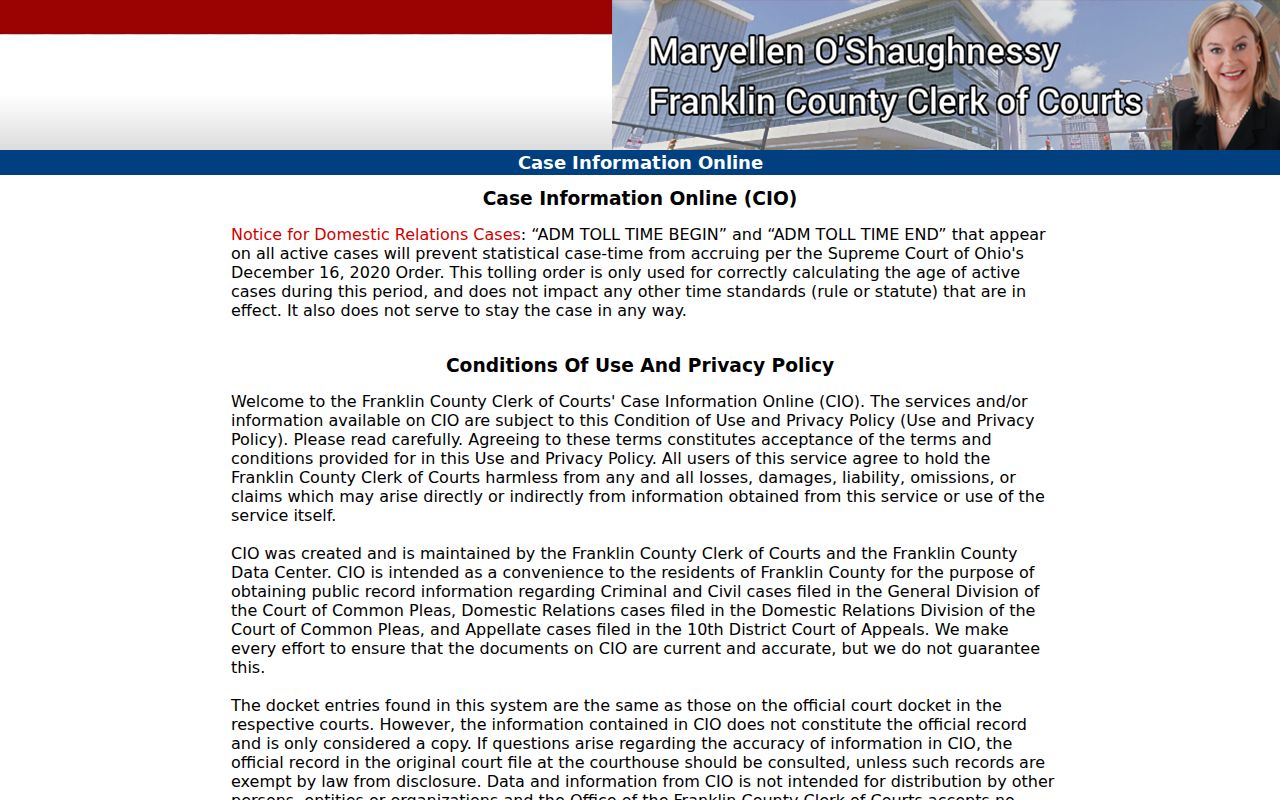
The official file controls when the accuracy of a CIO entry matters.
Note: Courts can restrict or redact juvenile, adoption, sealed, expunged, protected-address, and other confidential material under the applicable rules.
Verifying a Whitehall Resident Lookup
Verification means testing one record against another record that answers a different question. Preserve each spelling exactly as it appears, including initials, former surnames, suffixes, and business or entity variations. If a person may own a parcel, the Auditor’s Owner Name mode uses the form LastName FirstName; the resulting parcel and address can then be compared with a Recorder document. If the question concerns a case, choose the court with jurisdiction. If it concerns a marriage event, contact the Probate Court for the county that issued the license. Do not merge two people solely because both names appear in Franklin County material.
- Write down the full name and a second anchor such as an address, parcel identifier, case number, approximate event year, or business name.
- Use the custodian that fits the question and preserve the record’s own identifiers, including parcel, case, document, or court-division data.
- Compare a second official source that can test the anchor without filling gaps through assumption.
- Ask the holding office for an official copy, correction procedure, or record-specific confirmation if a detail affects an estate, family history, civic question, or safety concern.
- Docket
- A court’s running list of filings and events in a case. It identifies activity but is not automatically the official file or a finding of fact.
- Index versus image
- An index helps locate a record by name, number, or date. An image or paper file is the underlying document and may have different access rules.
- Certified copy
- A copy issued by the custodian with its certification. It is the appropriate route when a record requires official confirmation.
Whitehall Voter Checks for a Resident
Ohio’s Voter Search is designed to check registration and return precinct or polling-location information. It requires first name, last name, and county. The official tips recommend trying a derivative first name, a former surname, a previous Ohio address in another county, and a careful re-entry before concluding that no record exists. A possible match can then prompt for street-name selection. Franklin County’s Election Vault is a different channel: a public download list includes CITY_OR_VILLAGE_WHITEHALL.TXT, school-district Whitehall data, county files, and street-and-district material.
Franklin County Election Vault is a download catalog rather than a conventional name-query form.
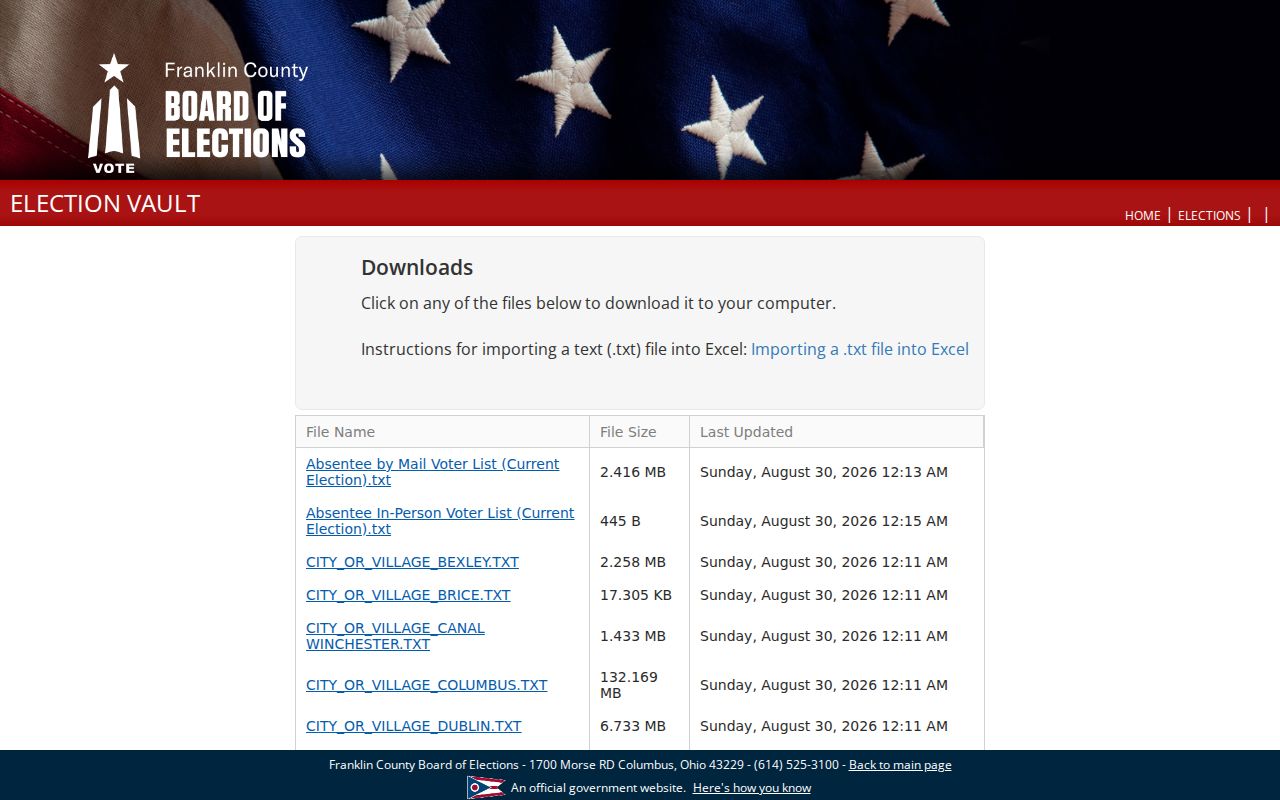
Read the displayed file date and documentation before relying on a downloadable Whitehall election record.
R.C. 3503.13 makes voter registration forms and the statewide database public records subject to statutory exclusions. R.C. 3503.153 identifies public display fields such as name, date of birth, residence address, precinct, registration date, participation history, and last activity, while protected records remain outside that display. Ballot selections are not part of this record inventory.
Whitehall Resident Lookup Vital and Probate Paths
Vital records answer event questions, not broad name-search questions. Columbus Public Health serves the Whitehall and Franklin County area for Ohio births from 1908 forward, Ohio deaths from 1971 forward, and Franklin County deaths from 1908 forward. Under R.C. 3705.23, a state or local registrar issues a certified vital record with a signed application and fee unless another statute restricts the material. Recent-death Social Security number access and the birth-record medical or health portion have special limits. Ohio Department of Health provides the statewide online birth-ordering route.
Ohio Vital Records Systems is an operational notice for partners, not a public person-search portal.
Use a verified local registrar, ODH route, or court custodian rather than sending personal or payment details to an unverified page.
For a Franklin County marriage abstract, Franklin County Probate Court’s General Case Search is the index route, and the certified-records process asks for the year or approximate year of marriage when the license was issued there.
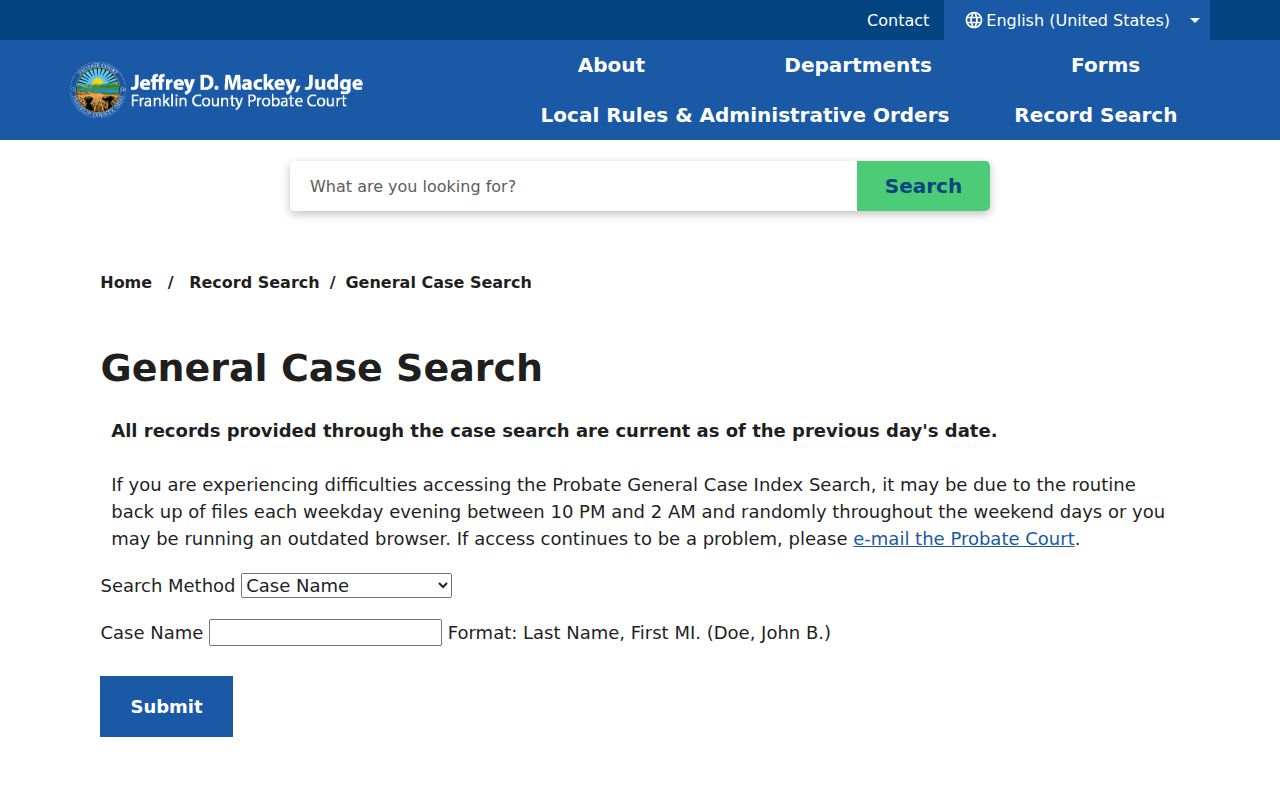
Probate results are current through the prior day, but a case index alone does not establish kinship or a person’s identity.
Whitehall Credential and Business Connections
Ohio Secretary of State Business Search can locate an entity or statutory-agent filing. The Secretary of State says it does not maintain ownership or officer lists, so an agent listing is a service-address connection rather than proof of ownership, management, or residence. eLicense Ohio is similarly narrow: it can confirm public credential status after the correct regulating board is selected. Published details can include status, board, credential type and number, issue or expiration dates, city, state, board action, and endorsements.
eLicense Ohio is the state’s board-specific license-verification gateway.
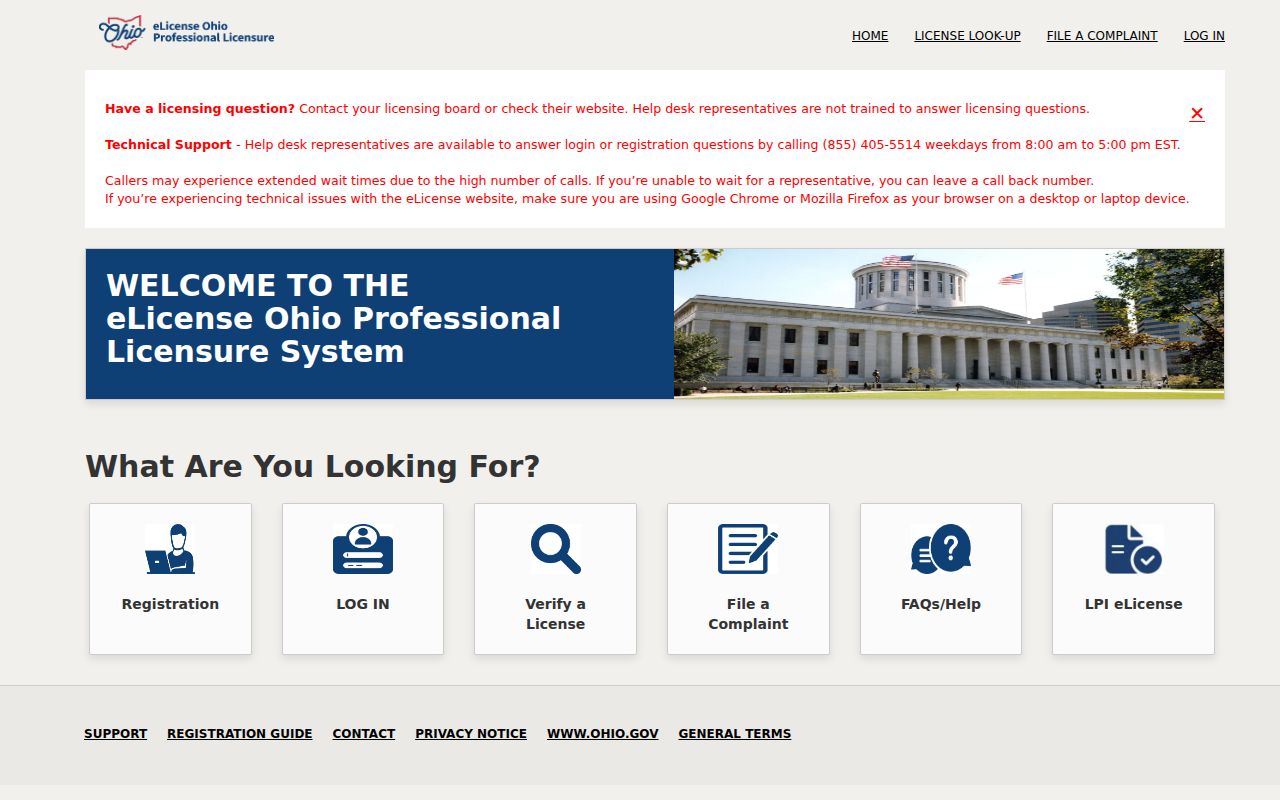
A license detail confirms a credential question only and should be verified with the named licensing board when current status matters.
This comparison keeps a resident lookup from overreading an affiliation record. Business filings and credentials can corroborate a known factual question, but neither should be used to construct a profile of a person.
Whitehall Resident Lookup Privacy Boundaries
Ohio Safe at Home is a decisive limit on a Whitehall resident lookup. R.C. 111.42 allows qualifying participants to obtain a Secretary of State-designated substitute address through a certified application assistant. R.C. 111.43 lets a participant ask government entities to use that substitute address and permits a real-property confidentiality notice with the county recorder. R.C. 149.43(A)(1)(ee) excludes participant identifying information, confidential addresses, related notices, and described geographic counts from public disclosure. An absence, redaction, or alternate address is never a reason to piece together a protected location.
Lawful use. Use Whitehall records for personal, civic, family, estate, or historical questions. Do not use record details to stalk, harass, threaten, or evade a safety protection; Ohio statutes include R.C. 2903.211 and R.C. 2917.21.
The Recorder can explain its document and certified-copy channels, while the Auditor lists a correction contact for property-data errors. A court entry should be addressed to the appropriate clerk, and a credential record to its licensing board. Correcting a record is different from removing a lawful public record.
Whitehall Records Requests When Search Stops
Ohio’s Public Records Act, R.C. 149.43, is the fallback when a public office holds a record but does not offer a dedicated search. The Attorney General explains that any person may inspect government records promptly and request copies within a reasonable period. Inspection is generally free; offices can charge actual copying, media, packing, delivery, and mailing costs, but ordinary electronic delivery does not add employee time or overhead. A request does not require the office to create a new record. When a request is ambiguous or overly broad, the office must explain how its records are organized and give the requester a chance to revise it.
Whitehall’s NextRequest FAQ says a requester need not provide a name or reason but should describe the record clearly enough for staff to locate it. Routine items may be filled immediately; larger requests are acknowledged within three business days with an estimated time and cost. For historical questions that a records office does not hold, CML Local History & Genealogy and the FCGHS collection at Main Library are the documented alternatives.
Note: A narrow request identifies the record type, date range, address or case number, and preferred electronic format without trying to obtain protected information.