
Whitehall Previous Residents by Era
Whitehall previous residents are best approached as an address history with separate date ranges. Franklin County Recorder material supplies the title trail, but it is indexed by people and documents rather than street address. The Columbus Metropolitan Library adds annual directory clues, and released federal census schedules offer a period household snapshot. Tax duplicates, newspapers, and city-held permit or code material can fill specific gaps, although no verified Whitehall permit start year was located. Start with the source nearest the period in question, then use its names, parcel references, and dates to move to the next record.
| Source | Years It Covers | Where Held | What It Shows |
|---|---|---|---|
| Recorder archival deed indexes | 1804-1913 | Franklin County Recorder legacy/archive search | Historic grantor and grantee index pages with volume/page retrieval. |
| Recorder deed index | From January 2, 1914 | Recorder Cloud and legacy searches | Recorded document and party trail, not a street-address index. |
| Columbus city directories | From 1841; catalog evidence 1843-1889 | CML Main Library and Digital Collections | Annual name and address clues; confirm Whitehall inclusion in the chosen volume. |
| Federal census | 1790-1950 released as of 2026 | Library databases and NARA-supported access | A household snapshot that needs township, ward, and boundary care. |
| Columbus News Index and obituaries | Articles 1960-1997; obituaries 1934-1997 | Columbus Metropolitan Library | Name and event leads that require corroboration. |
The Recorder’s historical index is especially useful when a past resident trail reaches early Truro Township land. The selected entry must still be checked against the same legal description, plat, lot, or subdivision clue. A similar surname alone is not enough.
A view of the Recorder legacy archive search shows the older access route used for Whitehall previous residents.
The archive complements, rather than replaces, the current Recorder search. Its value is the 1804-1913 deed-index continuation.
Whitehall Previous Residents Through Deeds
A deed chain begins with a current parcel, not an old address label. Use the Franklin County Auditor Property Search by address, parcel ID, map, or intersection to identify the physical parcel and its owner-of-record result. Record the parcel ID and legal-description clues before opening the Recorder search. The Recorder then connects a current owner’s acquiring deed to the prior grantor. That seller is searched as a grantee to identify the seller’s earlier acquisition, and the loop repeats.
- Find the address in the Auditor property system and save the parcel ID, site address, owner field, and legal-description clue.
- Search the current owner or document information in the Recorder Cloud or legacy system and open the acquiring deed reference.
- Write down the recording date, document type, grantor, grantee, and instrument number or book/page placement.
- Search the prior seller as a grantee, then compare the legal description before accepting the earlier transaction as the same land.
- For the earlier archive, choose the historical grantor or grantee index, locate the surname page, note its volume/page reference, and use book lookup.
- Grantor
- The party transferring property in a recorded instrument.
- Grantee
- The party receiving property in that instrument.
- Chain of title
- The linked sequence of transfers for the same parcel or legal description.
- Legal description
- The lot, subdivision, condominium, survey, or metes-and-bounds identifier that ties a deed to land more reliably than an old street label.
The Recorder’s placement changes with age. Documents after May 15, 1997 can use a 15-digit instrument number. Records from October 10, 1980 through that date can also have a microfiche volume-letter-page sequence, while earlier material uses book, volume, and page. Preserve whichever reference appears instead of trying to force every era into one number format.
The Franklin County Recorder search gateways are the public entry points for the modern part of that loop.
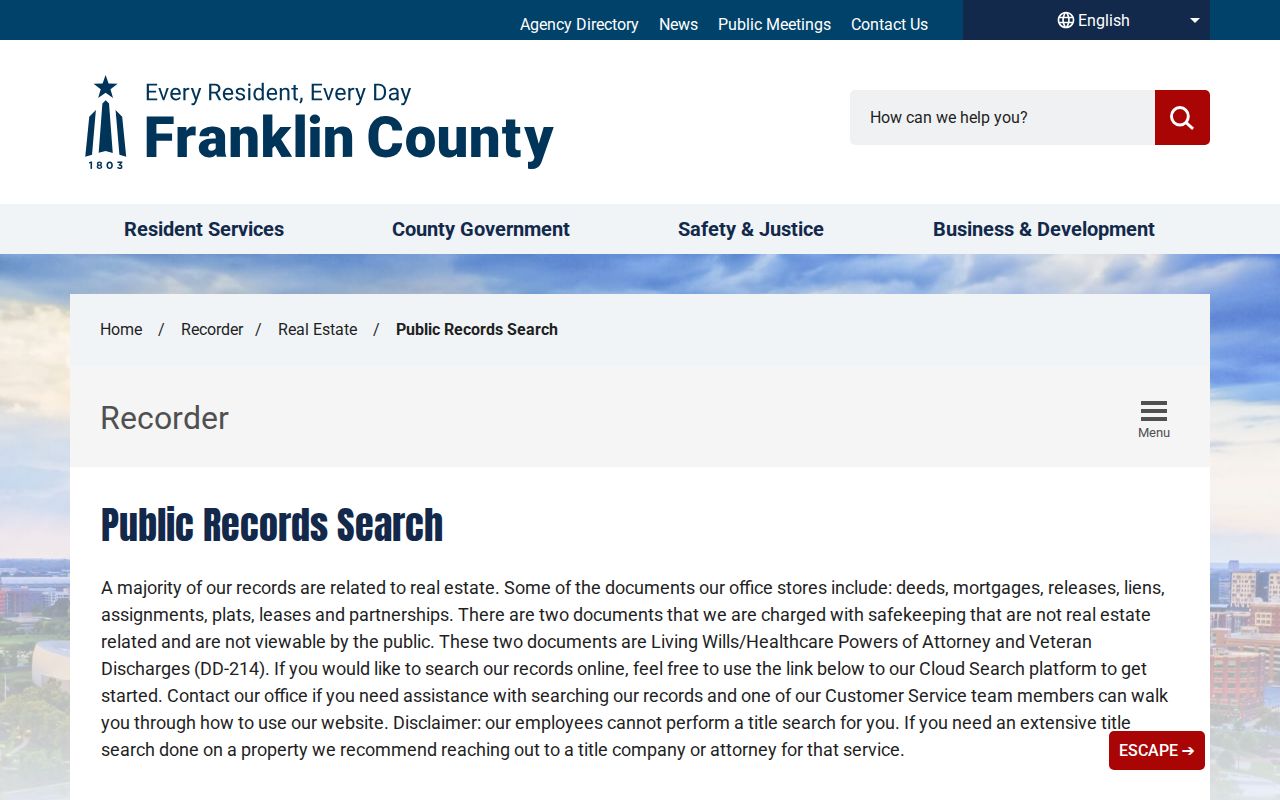
Both current Cloud Search and the legacy search are available without registration, although registration can add functions on the legacy platform.
Whitehall Past Residents Before Incorporation
Older Whitehall records need a wider geographic vocabulary. The city history places land east of Alum Creek in Truro Township and identifies an 1836 transfer as the earliest “White Hall” reference. Whitehall incorporated in 1947. A census, deed, tax record, or directory from before that date may be cataloged under Truro Township, the tract, the National Road context, or another older local term instead of the city name.
Franklin County’s 1804-1913 deed archive reaches that earlier setting. Its official brochure also reports that an 1879 fire destroyed some records and that most were reconstructed. Treat an apparent gap as a reason to inspect the historical grantor/grantee index, volume/page route, Recorder counter, and relevant archive help. It is not evidence that a missing name was never connected to the land.
Note: A changing municipal label is not proof of a changed address, so retain the legal description and any plat reference throughout the search.
Whitehall Past Households in Directories
For past residents rather than title parties, use the library shelf as a household clue layer. The Columbus Metropolitan Library house-history guidance describes annual city directories beginning in 1841 and says they list residents and addresses. Its catalog has Columbus City Directory material for 1843-1889, while digitization continues. The library says address-arranged material becomes available from 1911. A selected volume must be checked for Whitehall coverage rather than assumed to contain every city address.
Pair a directory finding with the nearest released federal census. First, note the historical address and name exactly as printed. Next, check the census place naming, township or ward, and enumeration before treating the household as the same location. Then return to the parcel trail and local newspaper or obituary index for a corroborating date or event. The collection depth belongs with the historical volumes, so the Whitehall city directory page is the natural next stop when several years need review.
Directories, census schedules, and obituaries each have blind spots. They can suggest a household’s place in time, but the deed chain remains the stronger evidence that a transfer involved the same land.
A snapshot of the Franklin County Recorder real-estate records page provides the official context for documents that anchor a directory clue.
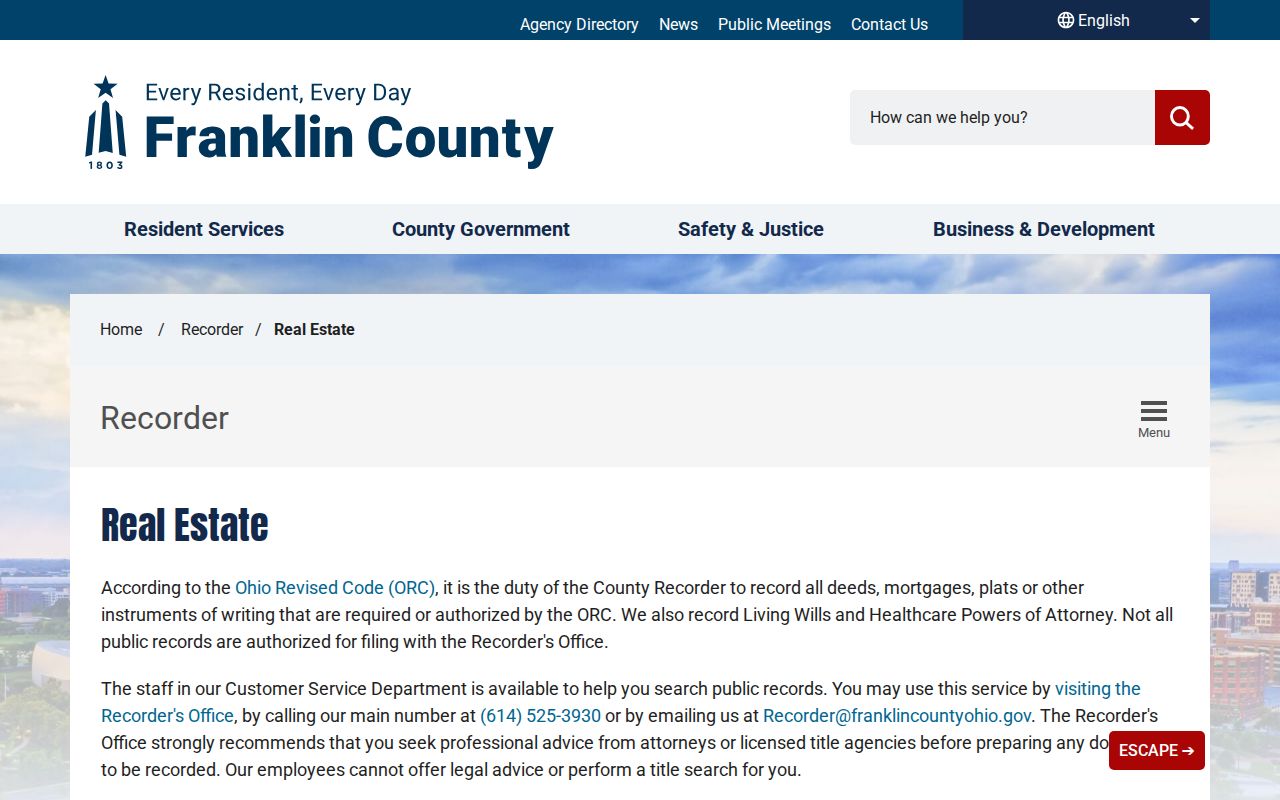
The Recorder lists deeds, mortgages, liens, releases, plats, leases, and related recorded material, each with a different purpose in the address trail.
Whitehall Previous Residents and Address Continuity
The Recorder does not index property by street address. That quirk makes the Auditor-to-Recorder handoff essential for previous residents research. A street address is a situs, the physical location used for assessment and navigation. It may change in how it is written across periods. The legal description identifies the land through a lot, subdivision, condominium, survey, or metes-and-bounds statement and is the durable bridge to deeds and plats.
Use the Recorder’s legal-description, subdivision, book/page, and party routes when an old street label does not produce a clean result. If a parcel was split, combined, or held by a trustee or entity, pause the chain and compare the named plat or document reference. The Recorder counter can help users search, although staff cannot perform a title search or provide legal advice. Its customer-service contacts are 614-525-3930 and recorder@franklincountyohio.gov.
Note: An owner mailing or contact address, if displayed in a property record, is a correspondence clue and never proof that the owner lived at the site.
Whitehall Previous Residents and Estate Endpoints
Probate can provide an endpoint when the address trail reaches an estate. The Franklin County Probate General Case Search covers estates, guardianships, marriages, adoptions, name changes, trusts, and related matters, with results stated to be current through the prior day. An index entry may identify a case route, but the permitted court file, docket, or official copy controls any relationship conclusion.
For a Franklin County marriage abstract, the Probate Court asks for the year of marriage and accepts an approximate year to help locate the record. Certified document needs should go through the custodian rather than an unofficial offer. The Recorder says unofficial web copies may be printed free, and its certified-copy route supports online, mail, and in-person requests at the stated $2 per page plus $1 certification per document, with postage where applicable.
The Recorder certified-copy request page shows the official channel for a document that must be obtained from the custodian.
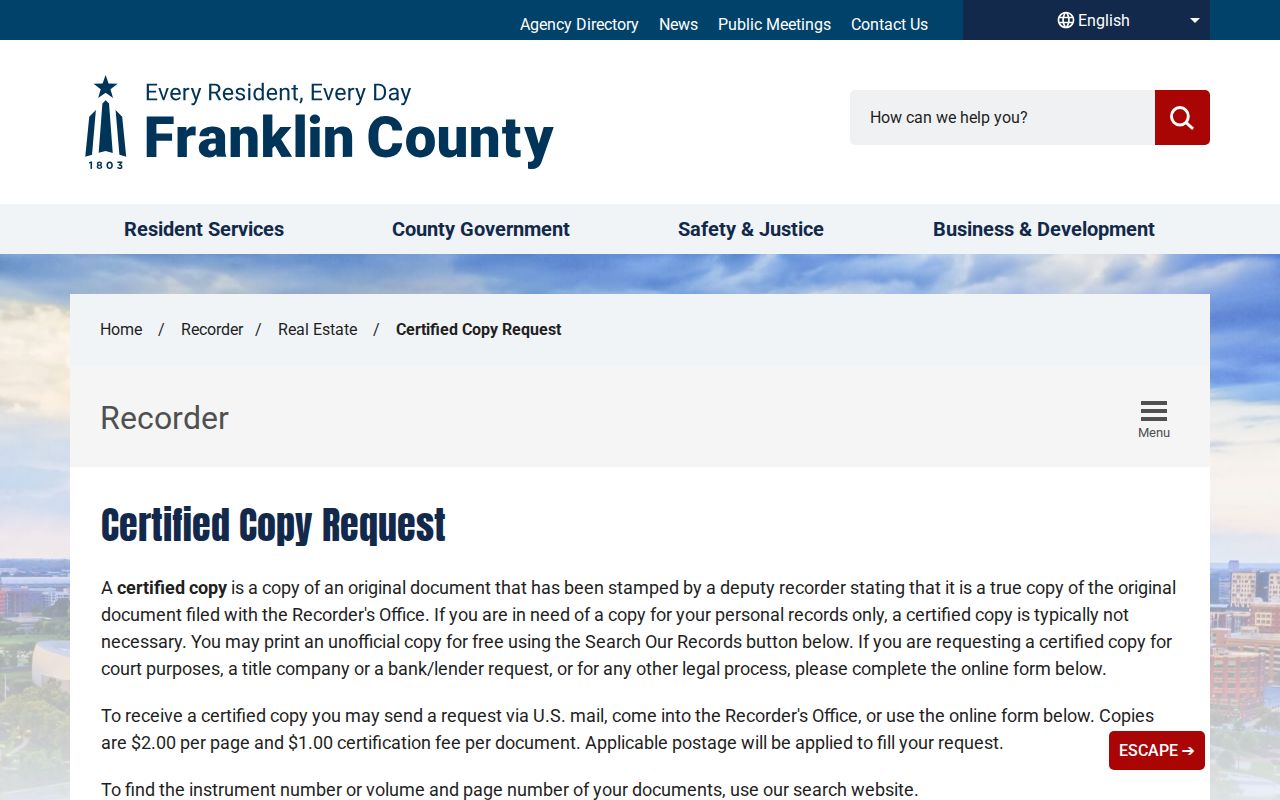
Use a certified copy only when the actual purpose requires one; a web index reference is not the same thing as an official copy.
The Franklin County Probate certified-records route is the matching court channel for a marriage abstract.
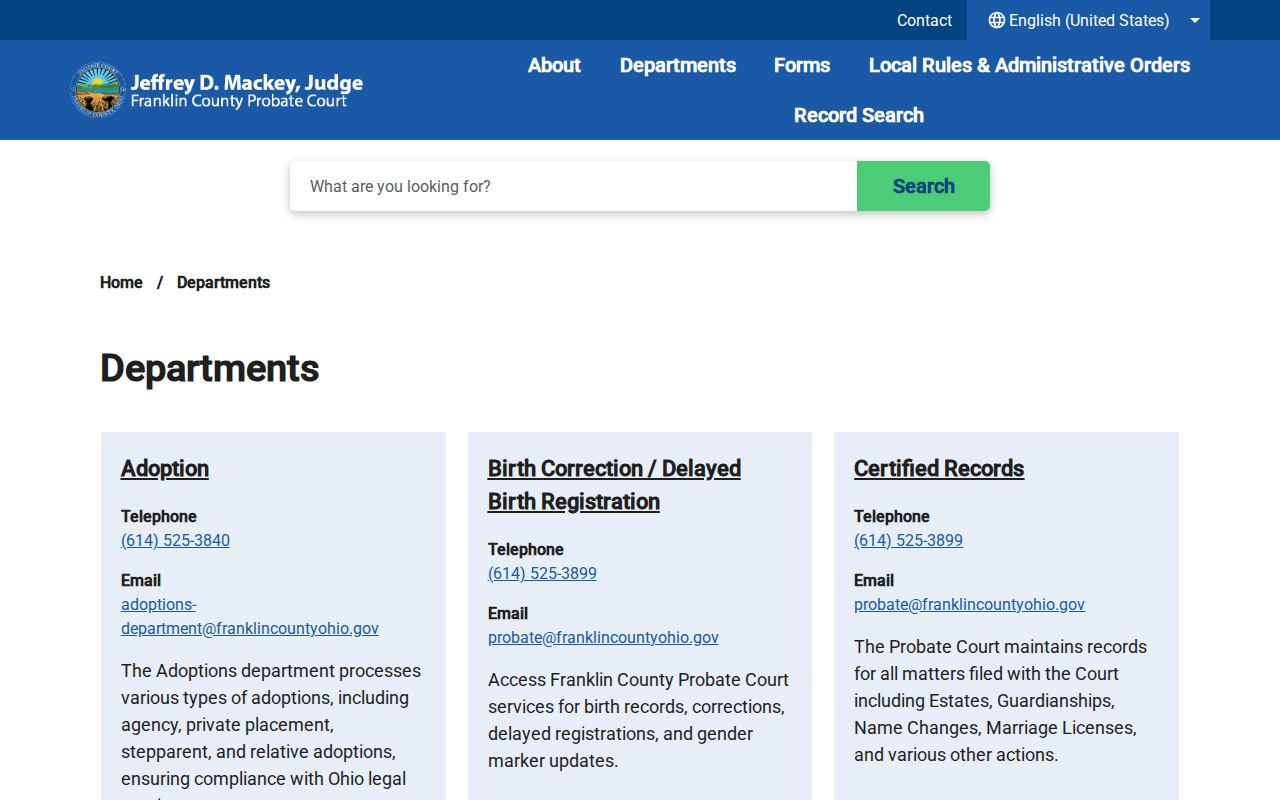
Estate, marriage, and other probate records should be read within their court context and may have access limits.
Whitehall Past Residents Beyond Online Indexes
When a search stops online, move through the documented fallbacks. The Columbus Metropolitan Library Main Library Local History & Genealogy team offers browsing without appointment, a one-hour in-person research consultation, Ask a Librarian assistance, and up to six free recent United States obituary requests per month. The Franklin County Genealogical & Historical Society collection in the Main Library genealogy department adds local and county histories, maps, directories, and family materials. Ohio History Connection is the CML-named route for historic Franklin County tax duplicates.
CML’s house-history guide lists Columbus Sanborn map years, but a complete Whitehall sheet run was not verified. Ask library staff, the historical society, Ohio History Connection, or the appropriate municipal source whether the selected tract is covered before relying on a map date. For city-held material, make a focused Whitehall request that identifies the address, record type, and date range. The city’s NextRequest records information says a requester does not need to provide a name or reason, but the item must be described clearly enough to locate.
Whitehall Previous Residents and Lawful Use
Past residents research is suited to house history, family history, estate questions, and personal curiosity. It does not authorize attempts to identify a protected address or to turn an old record into a claim about a living person. Ohio Safe at Home information is protected, and public records can also be redacted, sealed, or restricted. A missing record may reflect a legal protection or a gap in the source, not an invitation to cross-reference around it.
Lawful use. Use Whitehall address history for lawful personal and historical purposes only. Ohio laws on menacing by stalking, R.C. 2903.211, and telecommunications harassment, R.C. 2917.21, underscore that records must never be used to harass, threaten, or track a person.
Note: Verify consequential facts with the Recorder, Probate Court, Auditor, library, or city custodian that holds the underlying record.