
Finding Whitehall Resident Records
No single official list names everyone in Whitehall. Franklin County splits the work across several offices, each with a purpose. The Auditor links a parcel or address to owners of record. The Recorder ties names to deeds. The Board of Elections and the Secretary of State run registration tools under statutory protections. Columbus Metropolitan Library keeps the regional historical shelf. A productive Whitehall residents directory search starts by picking which relationship matters. Expecting one result to list every occupant will slow you down.
A current property question begins with an address. A person question needs two non-sensitive anchors. Think of a full name plus a known address or case number. A historic household needs a directory year or deed reference. Ownership, voter registration, court party status, and a printed directory entry are different facts. None of them proves a complete household alone.
- Use the Auditor's address, owner, parcel, map, or intersection route to find a Whitehall parcel.
- Save the parcel identifier and legal-description clues before moving to a deed search.
- Check the Recorder by party, document number, book and page, or legal description as the record permits.
- Use the voter self-lookup or Board channel only for its stated registration purpose.
- For a historic household, compare library directories with census, deed, and newspaper evidence.
Ask the custodian when the online route runs dry. The counter, library, certified-copy, and public-request channels each hold more. Note: an address search can start a Whitehall resident trail but cannot name every person tied to a home.
Whitehall Residents in Auditor Records
The Franklin County Auditor Property Search is Whitehall's main address-to-owner route. It offers several visible modes, including Owner Name, Address, Parcel ID, Subdivision & Condo, Advanced Search, Map Search, Intersection Search, Parcel Viewer, and Parcel History Sheets. Owner searches use the LastName FirstName form. Results display Parcel ID, Address, Owner 1, and Owner 2. Map-list and reporting controls refine the view. A partial parcel number without dashes works too. The Auditor warns that a failed exact match can return up to 500 records.
The roll is a property inventory. It places an owner of record beside a parcel and a physical address, but no other adults appear. A mailing or contact address on a live card can differ from the situs address. The situs is the physical street location. A legal description identifies the land by lot, subdivision, survey, or similar terms. The result stays useful without naming a household.
The Auditor's owner-search screen is the source shown below.
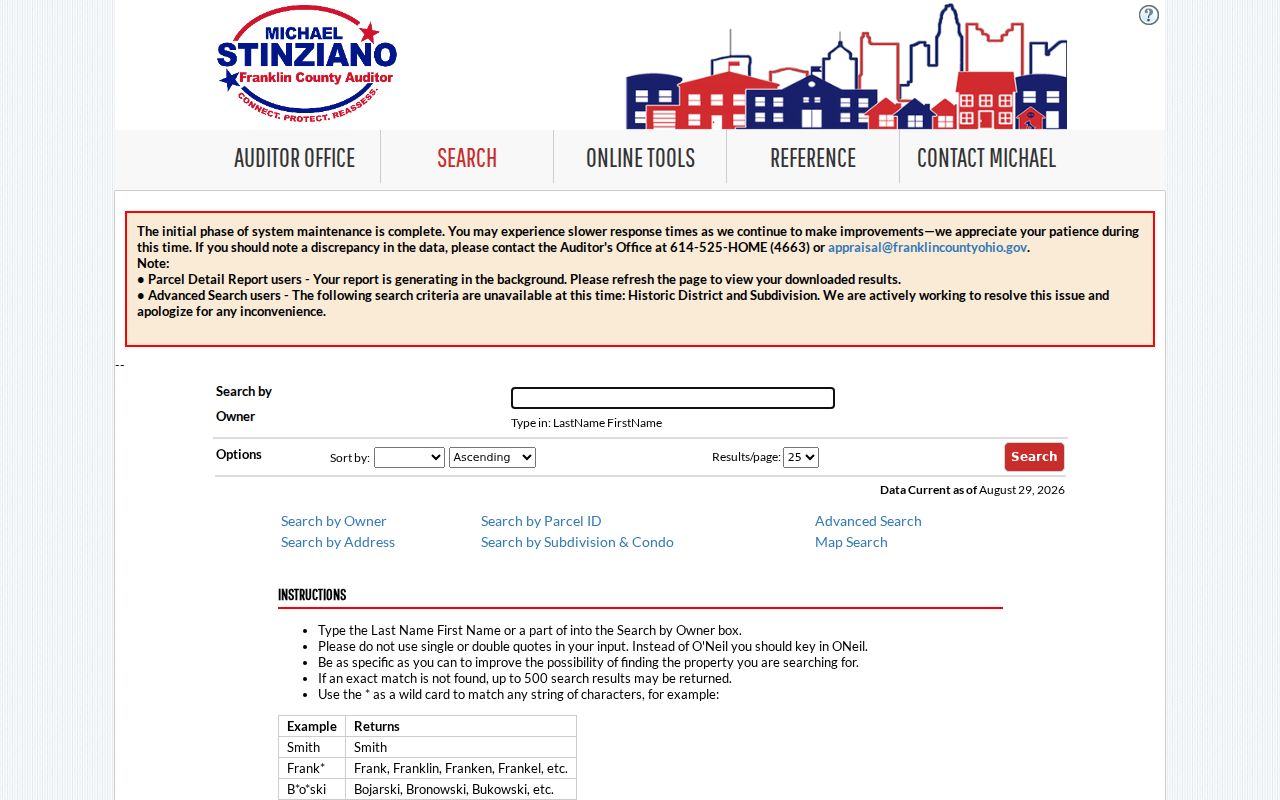
The screen supports a careful move from a Whitehall address to a parcel record. Deed or historical-directory work can follow from there.
| Auditor field or route | Use in a Whitehall search | Captured limit |
|---|---|---|
| Owner Name | Find owner-indexed parcels with LastName FirstName | Owner is not every occupant |
| Address or Map Search | Start from a known street location | Exact address instructions were not captured |
| Parcel ID | Carry the parcel trail into mapped and deed research | Use all or part of the number without dashes |
| View List-Map | Compare selected results with parcel geography | Not a resident roster |
Whitehall Deed Names Without Addresses
The trail changes shape at the Recorder. Franklin County Recorder Cloud Search and the legacy search are public routes. Neither needs an account for basic use. The office records deeds, mortgages, liens, assignments, plats, leases, and partnerships. The index runs by party and document. It is not a street-address directory, and that quirk shapes the method. Take the Auditor result first, then search by named party, instrument information, book and page, or legal-description clues from the parcel.
Cloud Search accepts a term for a grantor, grantee, subdivision, document type, or document number. It also offers date ranges, party tokens, document-type filtering, book-volume-page fields, a legal-description route, and an Index Only or Index & Full Text OCR scope. A grantor transfers property; a grantee receives it. Those roles can lead backward from a current deed. A matching surname still needs the legal description and record placement checked. Franklin County Recorder Cloud Search is pictured here.
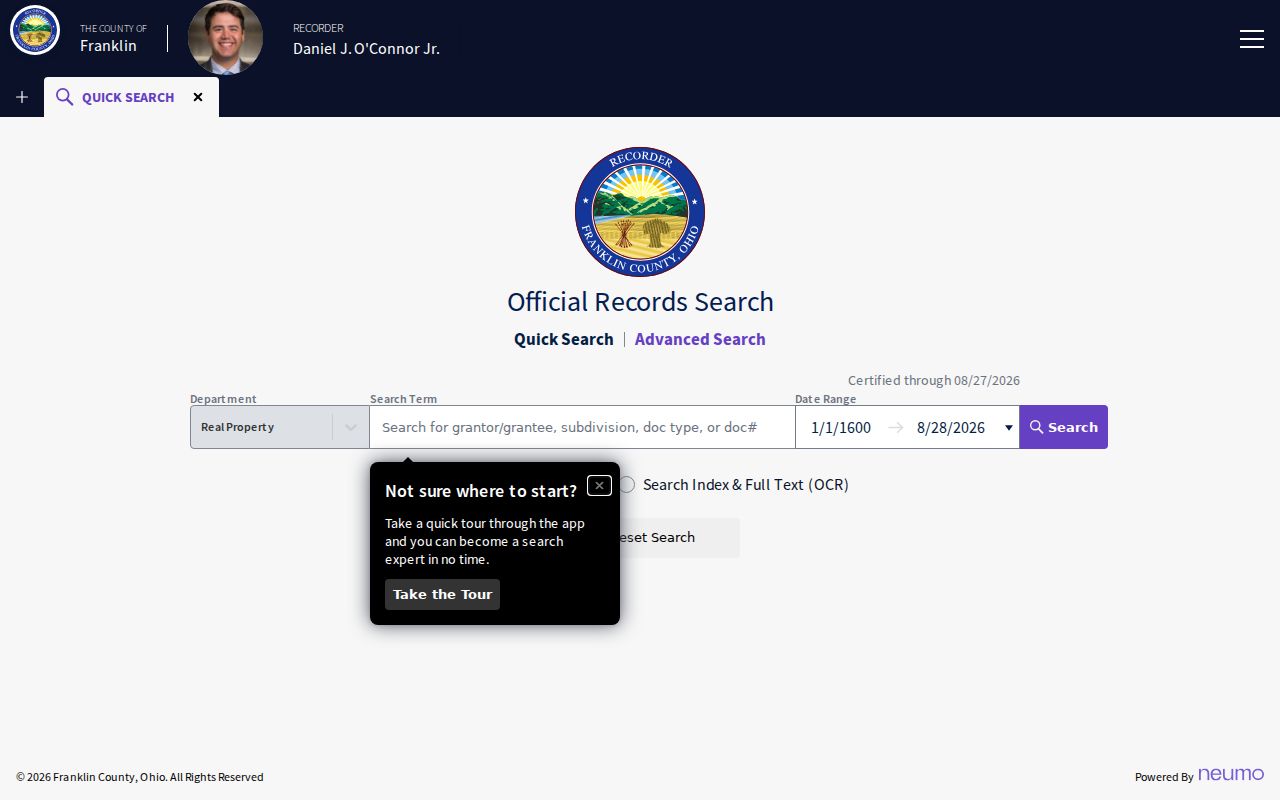
Recorder search works best after the parcel trail supplies a party name or legal reference. A street name alone goes nowhere.
Whitehall Voter Records and Elections
Ohio's statewide Voter Search asks for first name, last name, and county. It may also request a street-name choice to narrow a match. The tool checks registration, precinct, and polling information. Tips on the state page suggest a derivative first name, a former surname, a previous Ohio address, and careful re-entry. Franklin County is the right choice for Whitehall. The official statewide list and registration forms are public records. Exclusions apply under R.C. 3503.13.
Franklin County also publishes Election Vault downloads, including a city or village Whitehall file and street-portion-and-district data. The catalog is not a casual browse-by-address directory. Check the displayed download date and file documentation first. Protected voter records and Safe at Home information stay excluded, and neither route reveals ballot selections. Ohio's official Voter Search provides the form shown below.
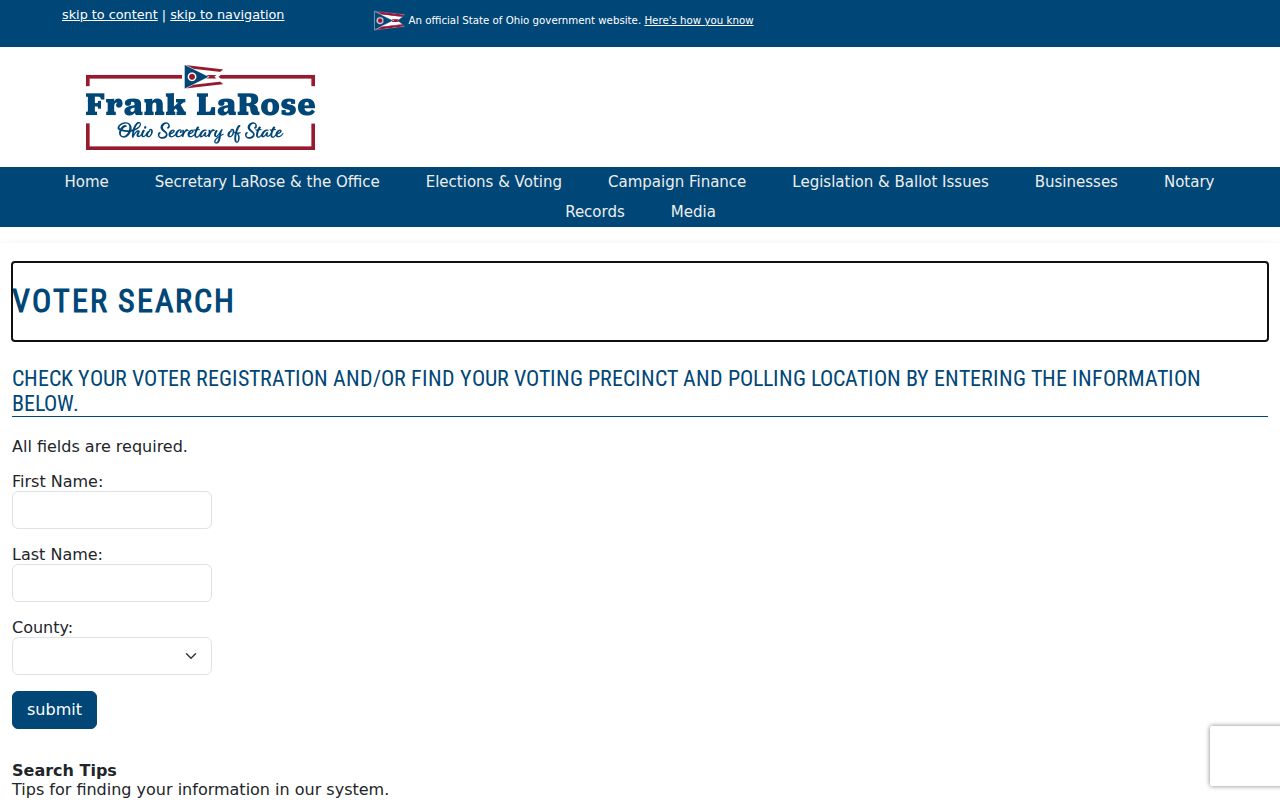
Whitehall's city records sit under Franklin County's elections jurisdiction, so set the county field.
Whitehall Resident Court Search Routes
A court index answers a different question than a residents directory entry. Whitehall Mayor's Court covers traffic cases, misdemeanors, and code enforcement under city ordinances. Franklin County Municipal Court posts a public party and case index. The Clerk's Case Information Online reaches Common Pleas criminal and civil files, Domestic Relations, and the Tenth District Court of Appeals. Probate holds estates, guardianships, marriages, name changes, and adoptions.
Municipal Court's search form accepts last, first, and middle names, date of birth, company, party type, case number, ticket number, case type, year, and status. A case or ticket number works fastest. The online docket is only a convenience copy. The Clerk states plainly that its online output is not the official record. Verification runs through the original file or a permitted copy. And a name match alone cannot prove two people are the same person. Franklin County Municipal Court's records search appears below.
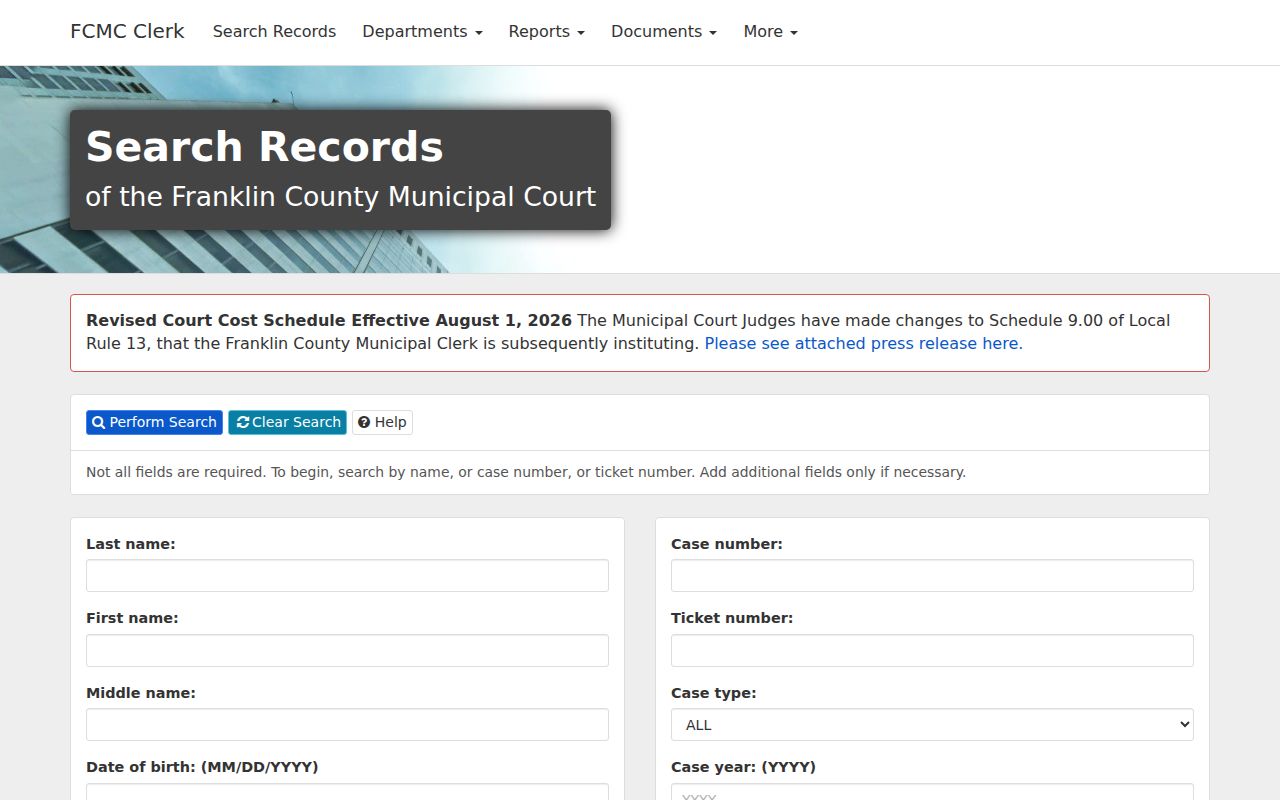
Those extra identifiers help separate a known party from someone else with the same name. Whitehall Mayor's Court information also names the local clerk and the court schedule.
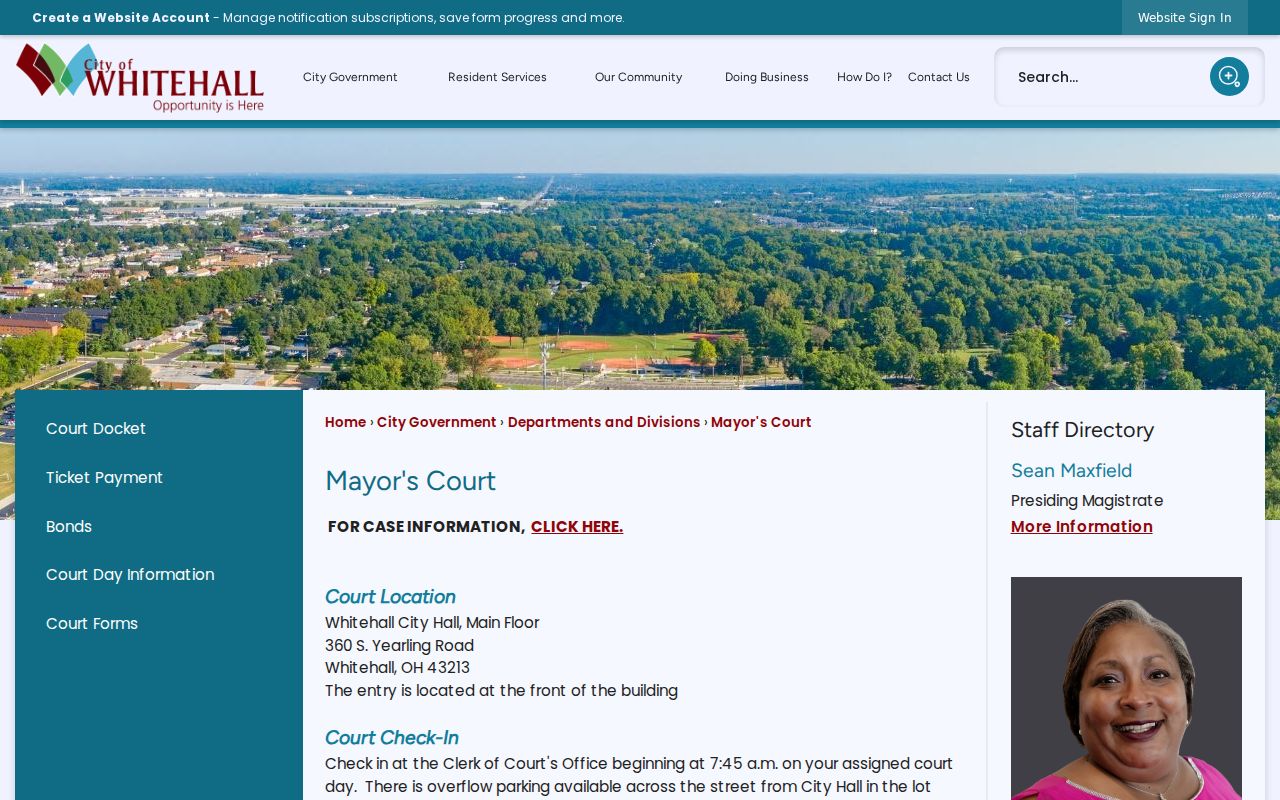
The Mayor's Court is its own city-level branch, not a stand-in for county or Probate court systems.
Whitehall Residents Directory Offices
Franklin County keeps the main property, deed, probate, court, and election layers for Whitehall. The City holds municipal records, including material reached through its request process. Each custodian can explain its own record and access channel. No office settles identity questions by guesswork, though. Want to work a named street from the address out? The Whitehall street directory carries the fuller workflow.
Franklin County Recorder
373 S. High St., 18th Floor
Columbus, OH 43215
614-525-3930
Franklin County Auditor
Property records are served countywide.
Use the official property-search route.
614-525-HOME (4663)
Property Search
Whitehall Residents and Postal Geography
Postal labels are not municipal boundaries. Whitehall City Hall uses ZIP Code 43213, and USPS ZIP Code Lookup is the authoritative check for any single delivery address. Franklin County parcel and ZIP layers give a second, narrower view. One county tax-parcel query for the City of Whitehall listed 5,159 parcels coded 43213, 445 coded 43227, three coded 43219, and 350 with no ZIP field. Those are tax-parcel values, not a claim about every delivery address.
The county's own ZIP polygons label Columbus as the postal city for 43213, 43219, and 43227. That mismatch is exactly why a Whitehall residents directory search should lean on USPS for delivery, city or county GIS for jurisdiction, and the Auditor for a specific parcel. An owner's mailing address, the postal city label, and the site's physical address can all differ.
- Parcel
- A unit of land tracked in the county property inventory.
- Situs address
- The physical street location used for assessment and mapping.
- Legal description
- The lot, subdivision, survey, or other land description that connects a parcel to a deed.
- ZIP+4
- A postal delivery refinement, not a separate city or jurisdiction.
Note: no official source establishes any second Whitehall street-delivery ZIP, a ZIP realignment, or a separate Whitehall post-office assignment.
Current Whitehall Residents Directory Sources
Current Whitehall resident sources do not all answer the same question. A property entry names an owner of record. A voter tool handles registration data under legal limits. A recorder hit places a person inside a legal instrument. A court index places a party in a case, not at a current address. The table keeps those uses apart. So a result gets checked with the right custodian instead of becoming one blended profile.
| Source | What it can confirm | Custodian | Access route |
|---|---|---|---|
| Auditor parcel record | Owner of record tied to a parcel | Franklin County Auditor | Public owner, address, parcel, and map modes |
| Voter registration route | Registration, precinct, or polling information | Ohio SOS / Franklin County BOE | Name, county, and documented public-file channels |
| Recorder index | Grantor, grantee, or instrument party | Franklin County Recorder | Cloud, legacy, counter, or certified-copy route |
| Probate case index | Estate or related probate case placement | Franklin County Probate Court | Index current through the prior day, then file/copy route |
| Historic directory collection | Past name, address, and often occupation clue | Columbus Metropolitan Library | Digital collection, Main Library, or research desk |
When the question turns on one identified person, the Whitehall resident lookup shows how to compare a name across official record types without merging same-named people.
Whitehall Vital and Probate Records
Vital records are certificate and event channels, not a general residents directory. Columbus Public Health serves the Whitehall area for Ohio births from 1908 forward. It also handles Ohio deaths from 1971 forward. Franklin County deaths date from 1908 forward. Ohio law, R.C. 3705.23, requires a signed application and fee unless another statute limits the material. Social Security data tied to recent deaths carry special restrictions. The medical portion of birth records carries special restrictions. The Ohio Department of Health offers the statewide path.
For a Franklin County marriage license, Probate is the custodian. It asks for the year, or a close estimate, when pulling an abstract. Estate, guardianship, and other Probate indexes can point family-history work in useful directions. The file itself and any permitted copy still control. A marriage or estate case is not evidence of a person's current Whitehall address. Columbus Public Health Vital Statistics is the source shown here.
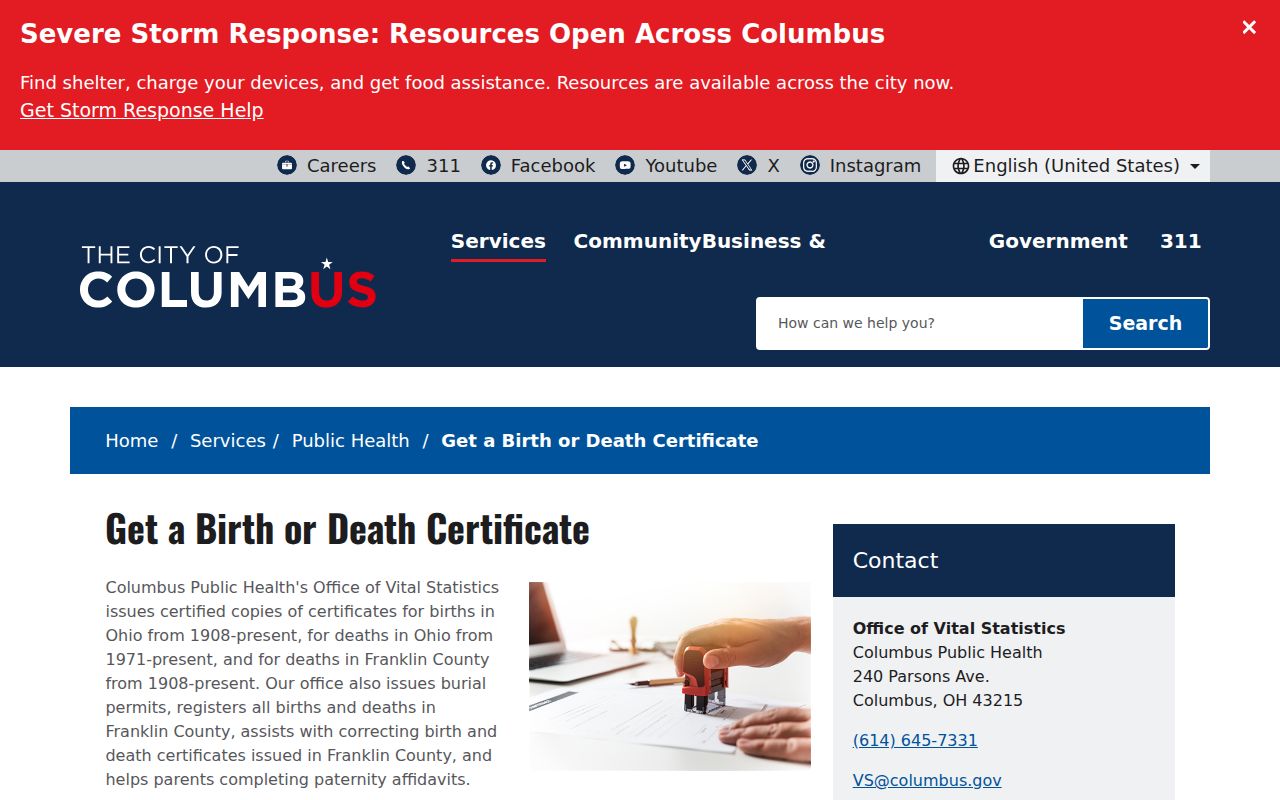
The local vital-record channel serves a specific event and application, not a broad person search.
Whitehall Records When Search Stops
Some Whitehall records exist but lack a public index. Go to the responsible office instead of the open web. The city routes requests through NextRequest and its departments. Minutes, permits, contracts, email, policies, and similar municipal records all fit those channels. No name or reason is required. The description just has to be clear enough for staff to locate the item. Routine material may arrive promptly. Larger requests are acknowledged within three business days, with a cost estimate attached.
Ohio's Public Records Act, R.C. 149.43, backs inspection and copy requests within a reasonable period. It never forces an office to create a new record. A too-broad request should draw an explanation of how records are organized, plus a chance to revise. Whitehall's FAQ prices copies plainly. Email records are free. Paper pages cost five cents after the first 20 free pages, a flash drive runs $5, a CD is $1, and mailing bills at actual cost. A date range, street address, case type, or record category makes a stronger request.
The Whitehall NextRequest public-record portal appears below.
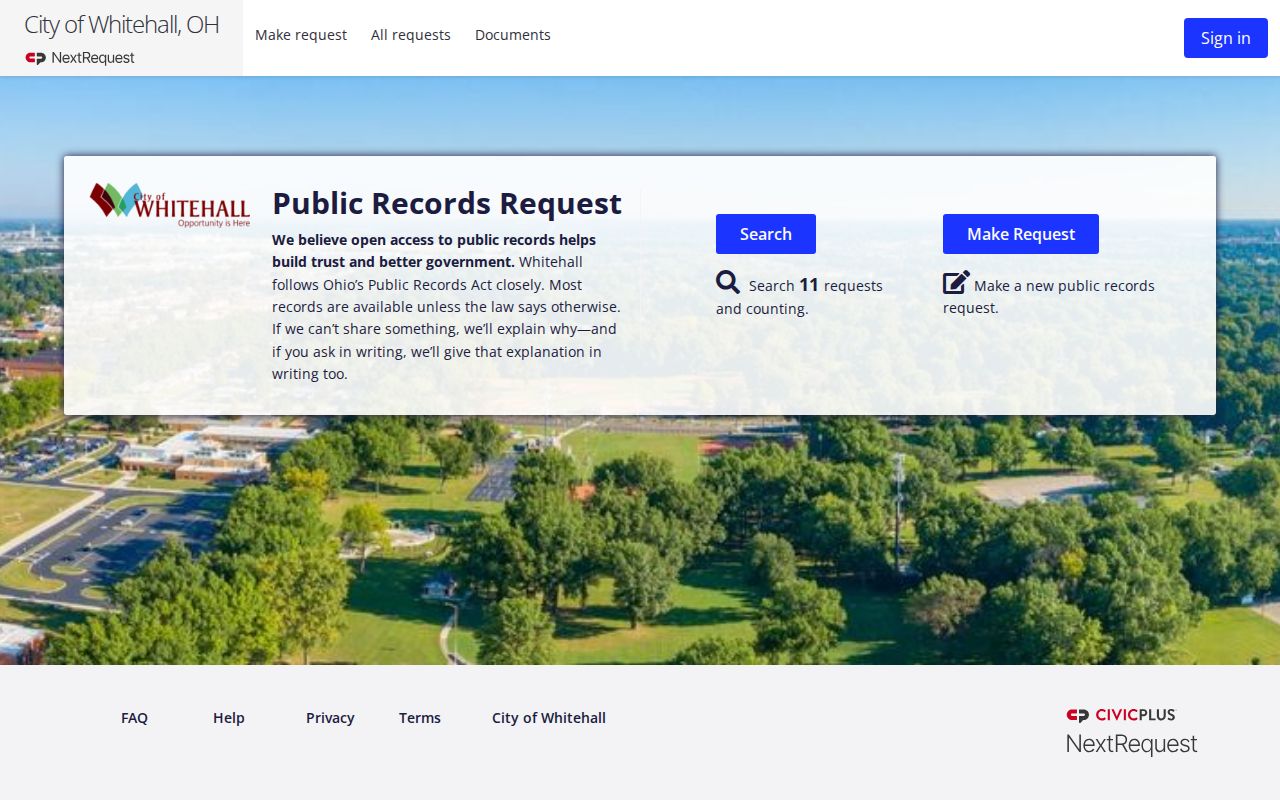
Online routes still complement the city counter and departments.
Whitehall Resident Records That Stay Private
Public access has defined boundaries. Safe at Home participants can use a Secretary of State substitute address under R.C. 111.42, and R.C. 149.43(A)(1)(ee) excludes their protected name, address, identifying information, applications, and related notices from public disclosure. Voter data also has exclusions. Court files can contain sealed, expunged, juvenile, adoption, confidential, or protected-address material. DMV information and utility-customer data are not general Whitehall resident records.
Missing, redacted, or alternate-address information is not a puzzle to solve by combining other sources. Public records exist for lawful personal, civic, historical, and family research. Verified mistakes should go to the relevant Auditor, Recorder, court clerk, or licensing board. The state public-records explanation helps distinguish an existing releasable record from one that is exempt or not kept.
Ohio's Public Records Act guidance provides the access baseline shown below.
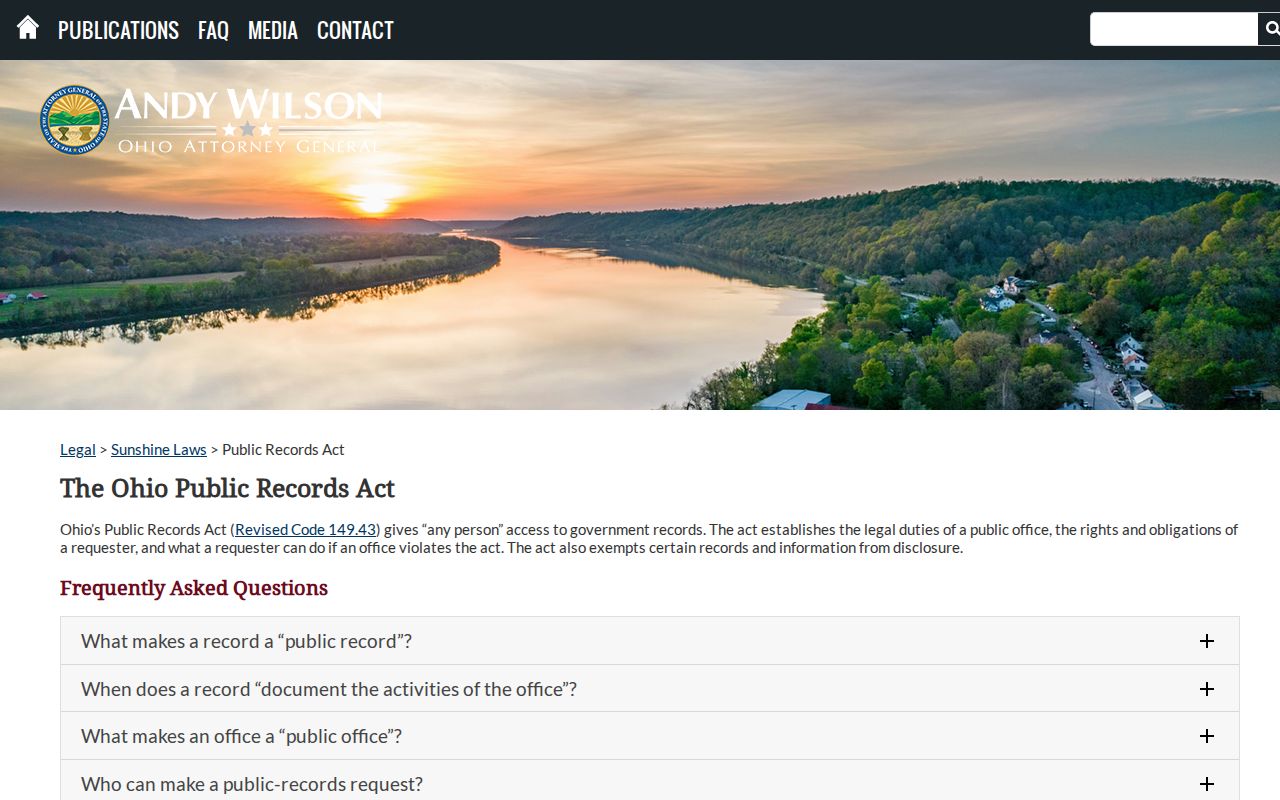
Exemptions and privacy protections still govern every government record.
Whitehall Resident Source Comparisons
Official records and commercial lookup products work differently. An official route names its custodian, its record purpose, and its access limit. A commercial result may blend old public material and licensed data. Some entries still need separate verification. Neither category replaces the source record. The source still decides a property, court, vital, or historical question.
| Official record route | Commercial lookup category |
|---|---|
| Names the public custodian and the underlying record type | May combine information from several sources |
| Offers a counter, request, or certified-copy path when available | Does not replace a custodian's verification channel |
| Has statutory exemptions and correction contacts | Can contain stale, incomplete, or mismatched entries |
Anchor any result to its official date and placement. For a deed, court file, certificate, or voter question, that habit keeps a same-name error from becoming a false conclusion.
Whitehall Records Before Cityhood
Older Whitehall research needs a geographic shift. Its land east of Alum Creek was Truro Township. The city did not incorporate until 1947. An early deed, tax list, census entry, or directory may instead say Truro Township, White Hall, a tract description, or National Road. The city history's earliest White Hall reference is an 1836 transfer. Searching only the modern city name can miss an older land or household trail.
Franklin County's Recorder archive spans 1804 through 1913. An 1879 fire destroyed some records. Most were reconstructed afterward. The archival method runs through a grantor or grantee surname page, a volume and page reference, and a book lookup. That history is a useful checkpoint for a family or deed search, not a guarantee that every early document survives online. Note: the archive's earlier coverage makes legal descriptions and township terms especially important for old Whitehall records.
Historical Whitehall Residents Directory Collections
Columbus Metropolitan Library's Main Library is the regional historical shelf for Whitehall. Its Local History & Genealogy service anchors that work. Digitization is underway. The aim covers most library directories back to the 1840s. Catalog evidence places a Columbus City Directory run at 1843-1889, while the library's house-history guide dates the annual directories from 1841. Early Franklin County phone directories appear in the digital collection too. Whitehall coverage must be checked in the selected volume. A Columbus title alone does not promise it.
Directory entries can yield a past name, address, and often an occupation. From 1911, city directories become address arranged. That offers an established reverse-address route. When digitization has a gap, the Local History & Genealogy service, the Franklin County Genealogical & Historical Society materials on the Main Library's third floor, and library staff are the fallback. The Whitehall city directory page develops the collections and the household-tracing method.
Columbus Metropolitan Library's My History gateway provides the historical entry point shown below.
The library's research desk and collections settle it. They are the right place to confirm a Whitehall appearance in a regional directory volume.